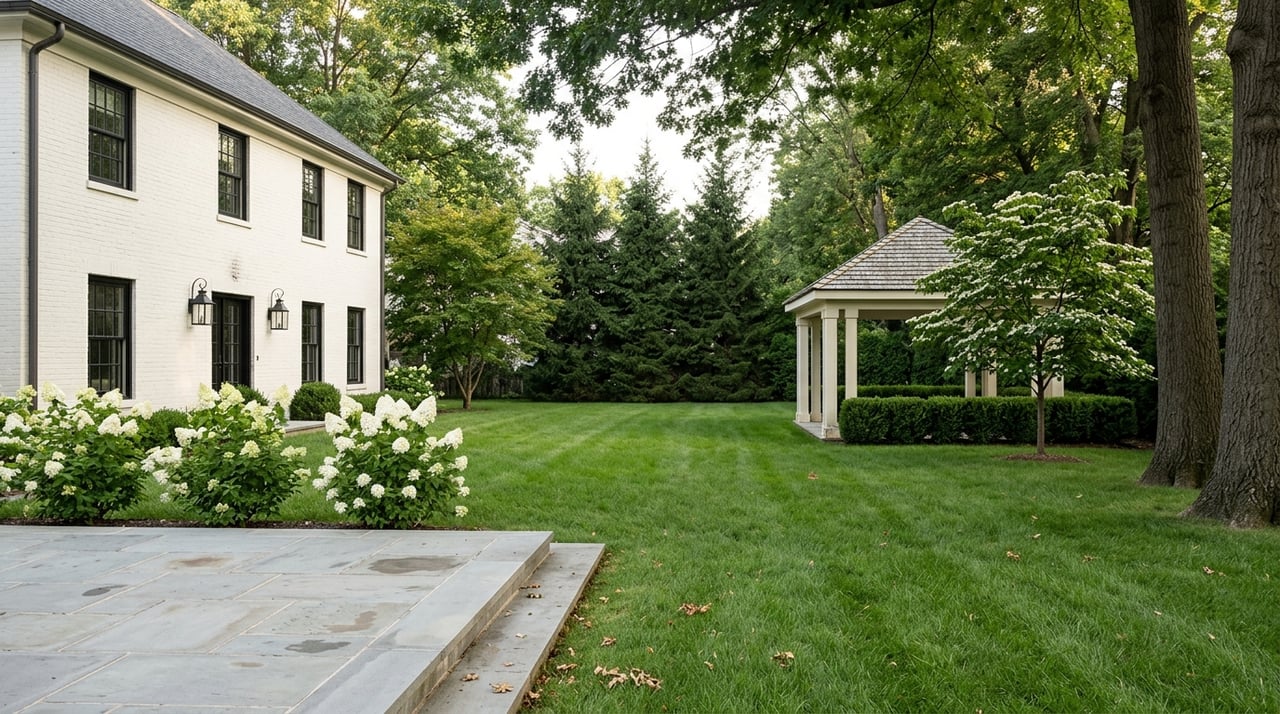
What to Expect From Large Lot Living in Upper Saddle River
If you picture Upper Saddle River as a place where homes sit with a little more breathing room, you are on the right track. Large-lot living here is shaped by real zoning rules, not just curb appeal, and that affects everything from privacy to outdoor space to future plans for the property. If you are thinking about buying or selling in 07458, this guide will help you understand what large-lot living actually looks like on the ground. Let’s dive in.
In Upper Saddle River, the borough’s residential zoning helps define the spacious feel many buyers notice right away. The two key residential standards highlighted in the borough code are R-1 and R-2, and they set different expectations for lot size, setbacks, and building coverage.
R-1 is the clearest example of the borough’s large-lot pattern. It requires a minimum lot area of 37,500 square feet, which is about 0.86 acre, along with 150 feet of frontage and 150 feet of depth. R-2 is more compact, with a 10,000-square-foot minimum lot, or about 0.23 acre, plus 100 feet of frontage and depth.
Those differences matter because they shape how a home sits on the land. In both districts, homes are limited to 35 feet in height and 2.5 stories, so the borough is not just preserving lot size. It is also keeping the overall scale of homes in balance with the surrounding streetscape.
Large-lot living is not only about square footage on paper. It changes how your property functions and how your home relates to the homes around it.
In R-1, required setbacks include 50 feet in the front and 35 feet on the sides and rear. Those dimensions create meaningful separation between neighboring homes and the street. For many buyers, that translates into a stronger sense of privacy and a less compressed neighborhood feel.
R-2 also includes setbacks, though they are smaller at 35 feet in the front, 15 feet on the sides, and 25 feet in the rear. Even there, the layout still reflects a lot-oriented suburban pattern rather than a denser format. The result is a residential environment where spacing remains part of the appeal.
Another big part of daily life is how much of the lot stays open. Building coverage is capped at 15% in R-1 and ranges from 15% to 20% in R-2 depending on lot size, which means a large portion of the parcel remains uncovered.
On a minimum R-1 lot, that allows about 5,625 square feet of building coverage. On a minimum R-2 lot, the building footprint is roughly 2,000 square feet. In practical terms, that often leaves more room for lawn space, landscaping, gardens, and outdoor gathering areas.
Upper Saddle River’s zoning also requires two off-street parking spaces per dwelling unit. That supports a residential pattern where driveways and garages are a standard part of the home layout. Compared with denser suburbs that lean more heavily on attached housing, the overall setup here tends to feel more spread out and vehicle-oriented.
The spacious atmosphere in Upper Saddle River is also supported by broader land-use patterns. Census QuickFacts reports that the borough has 5.25 square miles of land area and a 2020 population density of 1,590.1 people per square mile.
That context helps explain why the community often feels quieter and more open than tighter suburban markets nearby. It is not just the size of an individual property. It is also the way the borough is laid out overall.
Subdivision standards add to that effect. The borough’s rules state that minor streets should be designed to discourage through traffic, and they also call for natural features like trees, brooks, hilltops, and views to be preserved whenever possible.
A large lot does not always mean every part of the land is equally usable. This is one of the most important things to understand before you assume a property has easy room for a pool, addition, or expanded outdoor living area.
The total lot size is only the starting point. The required front, side, and rear setbacks reduce the area where a structure can actually sit. That means two homes with similar lot sizes may offer very different building options depending on lot shape and where the existing house is placed.
Upper Saddle River also requires lots to be large enough to contain a 150-foot circle in R-1 and a 100-foot circle in R-2. That lot-shape rule reinforces the borough’s spacious pattern, but it also shows why geometry matters as much as raw square footage.
Even when a property looks expansive, building coverage rules can still limit what you can do next. In R-1, only 15% of the lot can be covered by the building footprint. In R-2, the allowance is 20% on smaller lots and 15% on larger ones.
For buyers, the takeaway is simple. If you are thinking long term, do not focus only on acreage. You also want to understand the current footprint of the home and how close it already is to the permitted coverage limits.
The apparent size of a parcel is not the same thing as its practical flexibility. Upper Saddle River’s subdivision standards note that the Planning Board may withhold approval where a lot’s suitability is affected by conditions such as rock formations, flood conditions, inadequate soil-bearing capacity, or a high water table.
That means a property can look generous on paper but still come with real development limits. A survey, site review, and close look at borough requirements are essential if future expansion is part of your plan.
If you are shopping for a home in Upper Saddle River, large-lot living can offer a distinct lifestyle. You may find more separation from neighboring homes, more room for outdoor use, and a lower-density setting than in many nearby suburbs.
At the same time, it helps to ask a few smart questions early in the search:
These details can make a big difference in how a property fits your goals. A home can feel spacious today, but the right due diligence helps you understand whether it will also work well for your next chapter.
If you own a home in Upper Saddle River, your lot may be one of your strongest selling features. Buyers often respond to the privacy, yard space, and overall sense of separation that larger parcels can provide.
Still, the most effective marketing goes beyond saying a lot is “large.” It helps to explain how the property fits within the borough’s zoning framework and what that means in practical terms. Clear information about lot dimensions, setbacks, and outdoor usability can help buyers see the value more clearly.
This is especially important in a higher-value market. Census QuickFacts lists the median value of owner-occupied housing units in Upper Saddle River at $1,108,700 for 2020 through 2024, which reflects the premium nature of the local housing stock.
In a market like Upper Saddle River, two homes with similar asking prices can offer very different land value and future flexibility. That is why large-lot living is not something you want to evaluate by photos alone.
You want to look at the zoning district, the survey, the existing footprint, and the site conditions together. When you do, you get a more accurate picture of how the property lives today and how it may support your plans in the future.
Whether you are buying for privacy, outdoor space, or long-term potential, understanding the details behind the lot is part of making a smart move. If you are preparing to buy or sell in Upper Saddle River, The Ivanov Group can help you evaluate property value, lot positioning, and market strategy with the kind of local, data-informed guidance that high-stakes decisions deserve.
Stay up to date on the latest real estate trends.

Whether you're looking to invest, build, or find your dream home, The Ivanov Group is here to help. Contact us today to learn more about how we can be a part of your real estate success story.